How to Analyse Song Lyrics Like a Critic: A Beginner's Guide to Meaning and Metre
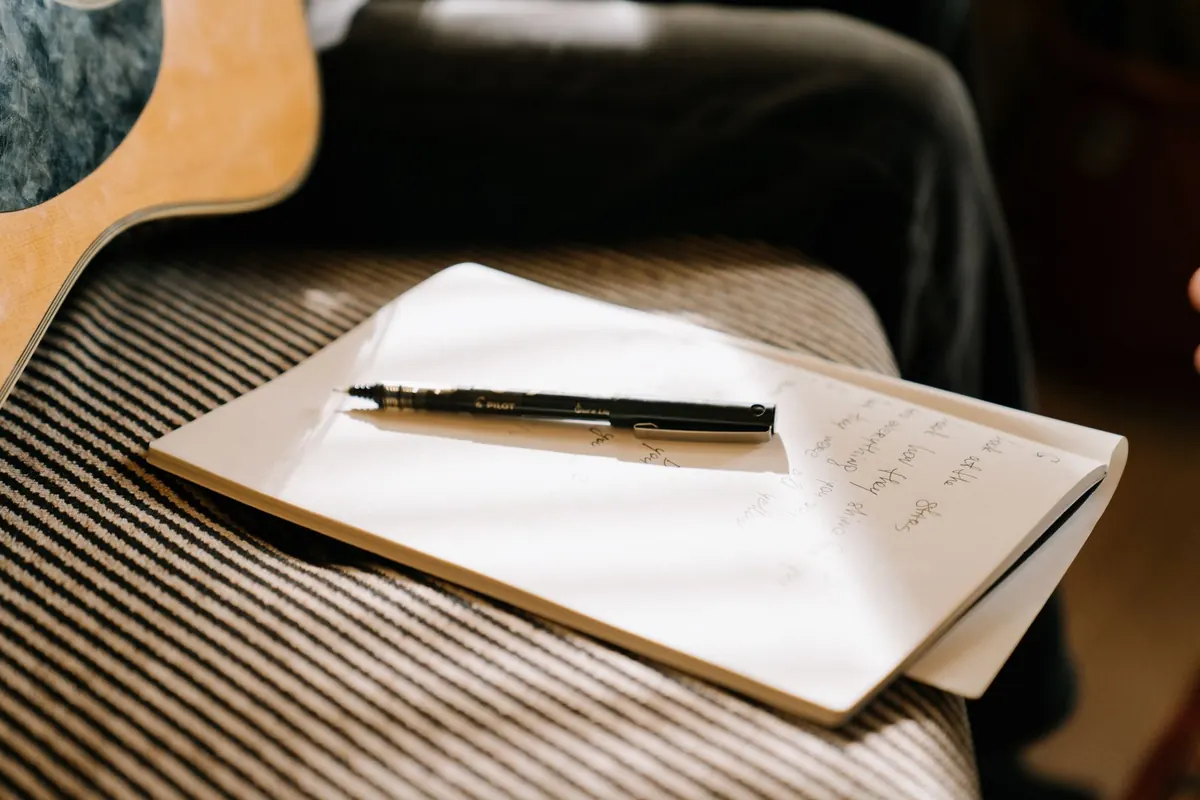
You can love a song for years without ever asking what it is doing to you. Then one afternoon a line lands differently, and you want to know why. Close reading is not an exam trick reserved for poetry seminars. It is just paying attention in a sensible order, using the same handful of questions each time, until noticing becomes automatic.
All you need is a pen, a printed copy of the words and twenty minutes. Work through the steps below in sequence, then repeat them on a second song and compare what you find.
Before you interpret anything, say what the song actually claims. Write a one-paragraph summary in your own words: who is speaking, what has happened, what has changed by the end. If you cannot summarise it, that is useful information — the song may be deliberately withholding plot, or you may be reading too quickly.
Now notice where your summary breaks down. A line like "the house is quiet now" paraphrases easily. A line like "I am the key you threw away" does not, and that resistance is the point. The moment plain sense stops working is the moment figurative language begins, and that is where the pressure of the song lives.
Imagery is not decoration. It is how a song thinks. Read through once and underline every concrete noun: objects, places, weather, bodies, clothes, roads, drinks. Then circle the abstractions — love, freedom, time, guilt. Songs that lean heavily on abstractions tend to feel vague; songs anchored in objects tend to feel trustworthy, even when the emotion is enormous.
Compare two ways of saying the same thing. "I miss you" tells you the feeling. "Your coat is still on the hook by the door" shows you a person who cannot move on. The second is doing work the first cannot.
Pay attention to the senses as well. Sight and sound are easy and common; smell, taste and touch are rarer, and they land harder because they arrive with a memory attached. Note repeated images too, and whether they change. Water that begins as rain and ends as a flood is not the same water.
A word of caution: not every image is a symbol. A car is sometimes just a car. Only reach for significance when the song itself keeps pressing on the detail.
Establish the voice. Is the narrator alone, or addressing someone? The word "you" is slippery in lyrics: it can be a lover, an absent parent, a younger self, a city, a god, or the listener. Try replacing "you" with each possibility and see which reading the rest of the song supports.
Then check the tense. A move from past to present usually marks a shift in the emotional argument — memory giving way to confrontation, or a promise being made in real time. Watch for a narrator who is not entirely reliable. A song can be an admission as easily as an accusation, and some of the best ones let the singer be the problem.
The voice in a song is a construction, even when it sounds like confession. Ask what the writer gains by adopting that position rather than another.
Mark the rhyme scheme in the margin — AABB, ABAB, or whatever pattern emerges. Full rhyme closes a thought neatly, which can feel satisfying or smug depending on the song. Slant rhyme (near, half, off) leaves a small unresolved hum, and writers often use it deliberately when the meaning should not sit still.
Repetition matters more in lyrics than in most poetry because a chorus returns. The same words can mean something different the third time around. Ask what has changed in the verses to make that repetition heavier.
Then listen to sound itself: the consonants that snap or soothe, the vowels the singer gets to hold. Long open vowels — "alone", "rain", "home" — carry across a melody in a way short clipped ones cannot. Where the vowels open up is usually where the song wants you to feel most.
Metre is simply the pattern of stressed and unstressed syllables. Read a verse aloud and tap the beat on the table. Mark each strong stress with a slash and each weak one with a cross. You are looking for two things: the underlying pattern, and the places the song breaks it.
Iambic lines, moving da-DUM, push forward. Trochaic lines, DUM-da, tend to fall and settle. Short lines feel clipped and breathless; long lines feel like overflow, an argument that will not stop. Meaning often sits in the disruption — an extra syllable, a stress where you expected none, a pause mid-line.
Try it on this invented verse:
I left the light on in the hall / I left the door ajar / and every car that slowed outside / was you, was you, was never you.
The first two lines are almost perfectly regular, four stresses then three, tidy and calm. The third stretches, and the last breaks into repetition, with the whole turn resting on one word: never. Stress that word out loud and the verse changes shape.
Finally, compare the written line with the sung one. Singers stretch syllables across bars, swallow others, and pull a phrase early or late against the beat. That gap between page and performance is not sloppiness — it is interpretation, and it tells you what the singer thinks the line means.
Keep a notebook with one page per song: a sentence of summary, a list of images, a rhyme map, a note on voice. Ten minutes is enough. After a dozen entries you will start hearing structure while the song plays, which is the real reward — not a clever interpretation, but a sharper ear.
Two habits will speed that up. Listen once with the lyrics in front of you and once without, so you notice what the melody is doing that the words alone cannot. And read songs in pairs: two breakup songs, two songs about a city, two choruses that repeat the same phrase to opposite effect. Comparison exposes technique faster than any single reading.
One last thing. Not every song rewards this treatment, and part of the skill is knowing when to put the pen down. Some lyrics are built to be argued with; others are built to be shouted along to in a kitchen. Learn to tell the difference, and you will enjoy both far more.
Photo: cottonbro studio / Pexels